
Long-horizon agent trajectories and failure attribution
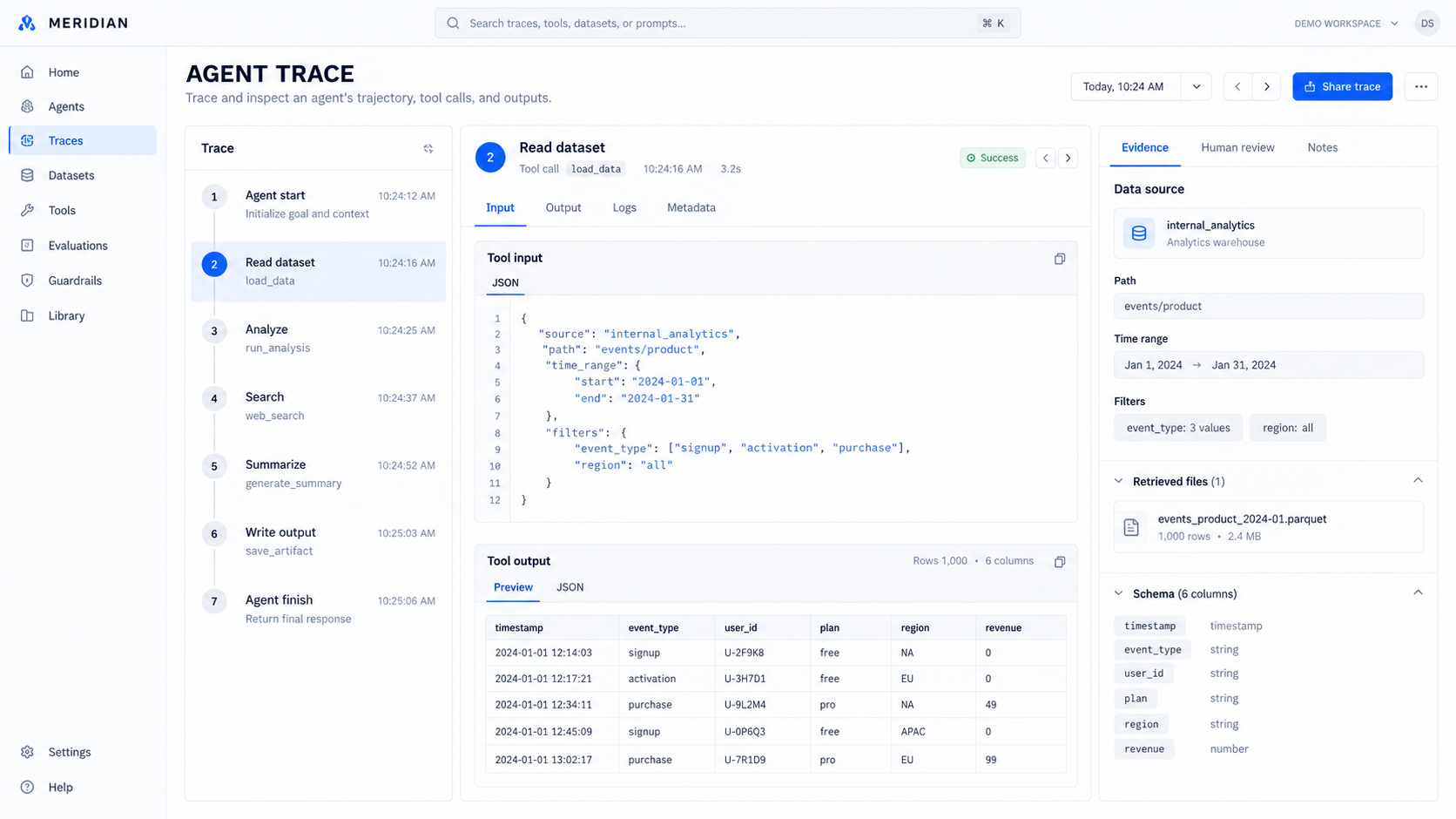
Node-level review from task intake and planning through tool use and final deliverables.
Task understanding before scale
A tool-using agent completed long-horizon work across files, browsers, code and structured data. Some final outputs were correct despite unstable retries and poor source selection. We retained the complete action–observation chain, then evaluated critical decisions, tool parameters, recovery, self-checks and stopping conditions. Failures were separated across task, plan, tool, execution, factuality, deliverable and judge layers; high-value failures were rewritten into improved post-training trajectories.
Complete action–observation–correction chain
Process quality separated from outcome quality
Trainable corrections tied to root cause
One structure aligns the questions asked by model, data, procurement and security teams.
Node-level review from task intake and planning through tool use and final deliverables.
Long-horizon agent runs across files, browsers, code and structured tools
Critical-node annotation, independent A/B review, root-cause attribution and trajectory correction
Representative batch of approximately 2,800 traces averaging 18 steps across six tool classes
Critical-node annotation × dual review × failure taxonomy; Trainable corrections tied to root cause
Complete action–observation–correction chain; Process quality separated from outcome quality; All critical nodes received review; high-value failures became post-training-ready corrections
Client identity, original material and selected volumes are removed or banded. This brief explains delivery method and does not guarantee future results.
A case file a technical team can interrogate
A correct final answer does not establish agent reliability. The operating question is whether the agent selected the right information, tools, sequence and stopping condition.
Freeze the run
Lock the task, environment, tool versions and action–observation sequence.
Identify critical nodes
Mark irreversible decisions, external calls, recovery attempts and final submission.
Independent review
Separate reviewers judge process quality, outcome quality and root-cause attribution.
Adjudicate disagreement
Retain the rationale and ruling for plan, tool, factual, execution or judge-layer disputes.
Correct the trace
Rewrite high-value failures as minimal, trainable changes rather than idealized demonstrations.
What does not enter the accepted batch
- Correct output built on the wrong or unverifiable source
- Repeated retries obscure a planning or tool-selection failure
- A failed intermediate state does not trigger recovery
- Premature stopping or an incomplete final deliverable
The handoff is more than an answer column
- Original action–observation trace
- Critical nodes and failure taxonomy
- A/B review and adjudication record
- Corrected trajectory with training-use labels
Trace packages can support agent regression evaluation, failure analysis, SFT or preference-data design. Sampling, weighting and data rights are confirmed before training use.
Review samples. Then define the task.
Carry this direction into your enquiry to confirm delivery, verification and sample scope.
Build data around your next capability goal
Start with a task goal and a sample. Define the materials, specialists, verification methods and delivery scope together.