
Longer horizons. Changing evidence. More demanding work. Axis Edge studies the gaps existing data leaves behind, maintains technical dialogue with leading model teams, and develops original task environments, references and verification methods.
Explore the Lifelong research sampleMemory × reasoning × verifiable execution
Research before release
Public evaluations, technical exchanges and project feedback shape the research question. Domain experts and engineers determine whether it can become useful data.
Frontier evaluation & technical dialogue
Study failure patterns, task environments and evaluation methods with technical contributors from leading model teams. Identify capabilities that existing data does not capture.
Original tasks & reference construction
Design materials, roles and information boundaries around a capability gap. Experts produce references; engineers turn acceptance requirements into executable checks.
Trials, review & versioned iteration
Check solvability, evidence and score discrimination. Record failure analysis and revisions before expanding the scope.
Lifelong EP001
A continuous 90-day context for information updates, role boundaries and historical evidence.
EP001 · Fictionalized M&A research scenario · Counts from company research material.
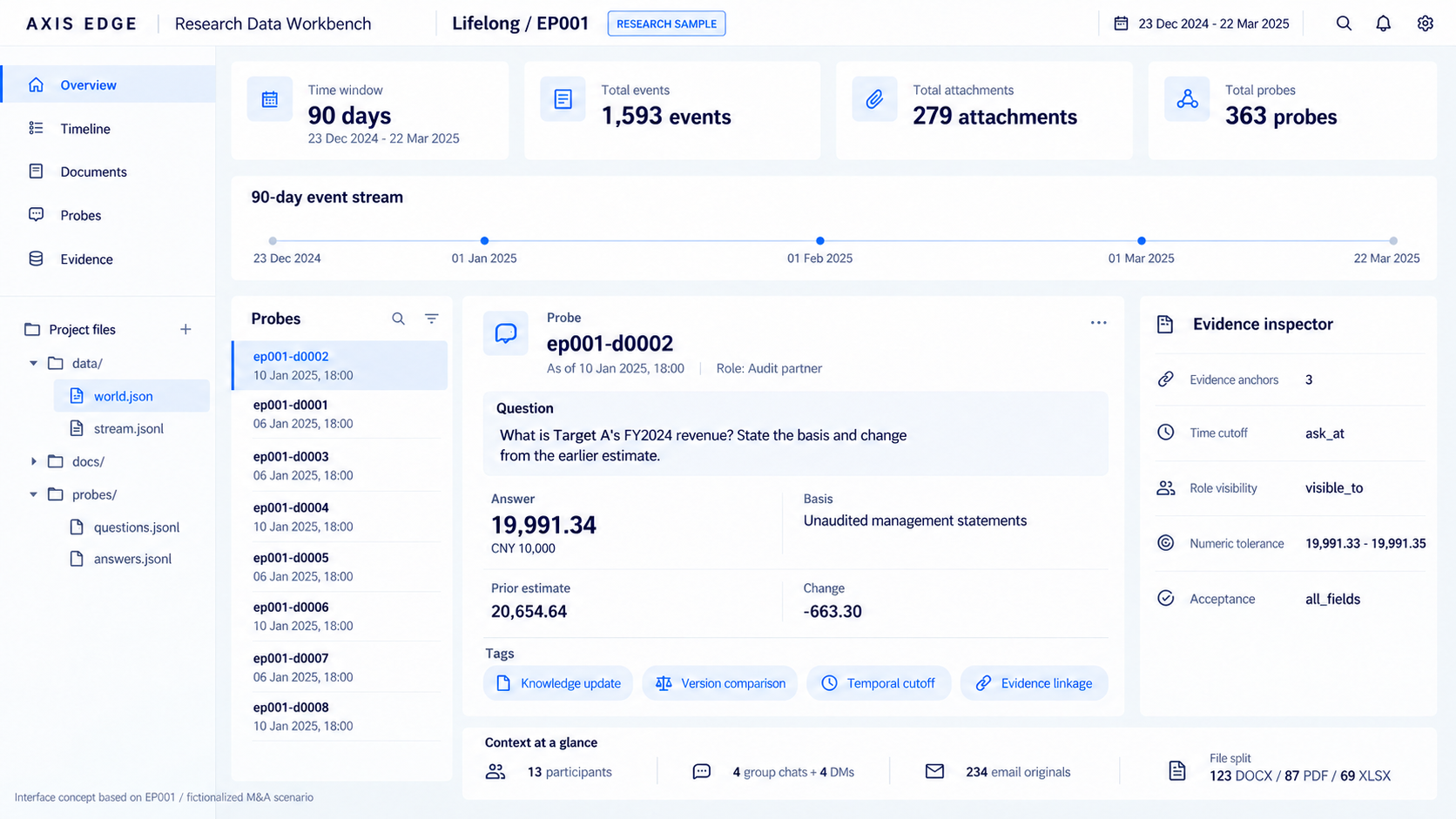
A traceable task world
13 participants, four group chats and four direct-message groups form an evolving project context. Eight task types and 363 probes include answer and evidence fields, with numeric tolerances or semantic criteria set per question.
Evaluate information boundaries
The question cutoff limits available history; role visibility limits accessible material. Version updates require the model to revise earlier beliefs. References must identify the basis, change and supporting evidence.
Example source: management_statement_v2.csv
What could this role know at this time?
Change the cutoff and role. The accessible evidence changes before the answer is checked.
Two versions and two roles illustrate the boundary logic. This is not a replay of the full EP001 dataset.
Target A · FY2024 revenue
Unaudited management statements. Updated from the earlier estimate of 20,654.64.
Revision: −663.30 CNY 10,000
Make collaboration between agents inspectable.
One agent’s correct answer does not guarantee that a team completes the work. We organize delegation, information boundaries, evidence handoffs and recovery into inspectable collaboration traces.
Scope of the sample on this page
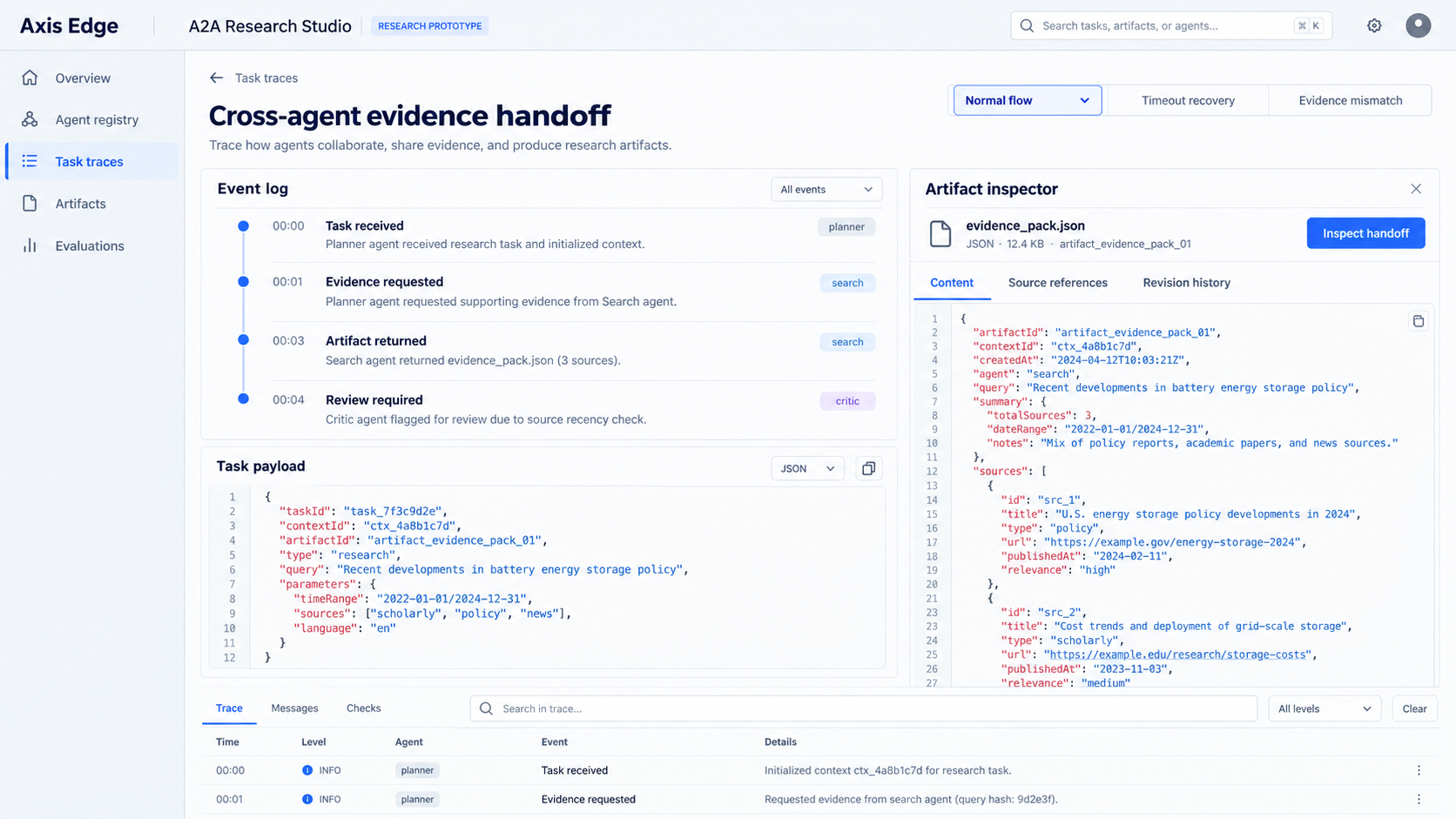
Task trace
1 / 4Handoff acceptance
A2A-001The reviewer requires evidence package v2. Change the received version and check whether the handoff meets the task contract.
- Task context
- ctx-demo-001
- Artifact
- evidence_pack.json
- Expected version
- v2
Task contracts
Retain goals, roles, input constraints and completion conditions so another agent can take over the delegated work.
Handoff evidence
Preserve sources, versions, task identifiers and artifacts to examine reliability across repeated handoffs.
Recovery behavior
Introduce timeouts, repeated responses, missing inputs and version conflicts; inspect clarification, retry and stopping behavior.
End-to-end acceptance
Check local artifact quality, collaboration and the final goal separately. A successful call alone does not establish task success.
From a collaboration to a research package.
Scenario specifications, agent capability descriptions, interaction traces, artifact references, fault conditions and acceptance rules form the sample package. The public demo focuses on version handoff; further tasks can be scoped around target capabilities.
Protocol reference: official A2A documentationPublic research we follow
We study task design and verification in public research, then turn observed capability gaps into original research material.
Study how dynamic state, workflow knowledge and environment-specific assumptions survive long histories.
Study environments, execution artifacts and reproducible verification for scientific tasks.
Study the translation of domain knowledge into code and verification through scientific constraints and numerical tests.